QTekLaser™ sum-frequency generation (SFG) fiber lasers mix two single-frequency Yb, Er and Tm fiber amplifiers, or one amplifier with a frequency-doubled Tm source, to reach wavelengths no single gain fiber or SHG stage can. The result is continuous coverage from 466 to 722 nm and from 812 to 904 nm at up to 20 W, with narrow linewidth, low noise and directly collimated output for quantum, atomic and precision applications.

One SFG platform
SHG covers the green and two near-IR bands; SFG fills the yellow, orange, red and 812–904 nm regions in between. Any wavelength inside these bands can be built. The examples are lines that are requested frequently.
Laser cooling and trapping, single-qubit gates and readout, Rydberg excitation, color-center control for quantum networking, photonic integrated circuit (PIC) validation and precision spectroscopy. Browse lasers by species, or see our SHG lasers for the green and near-IR bands:
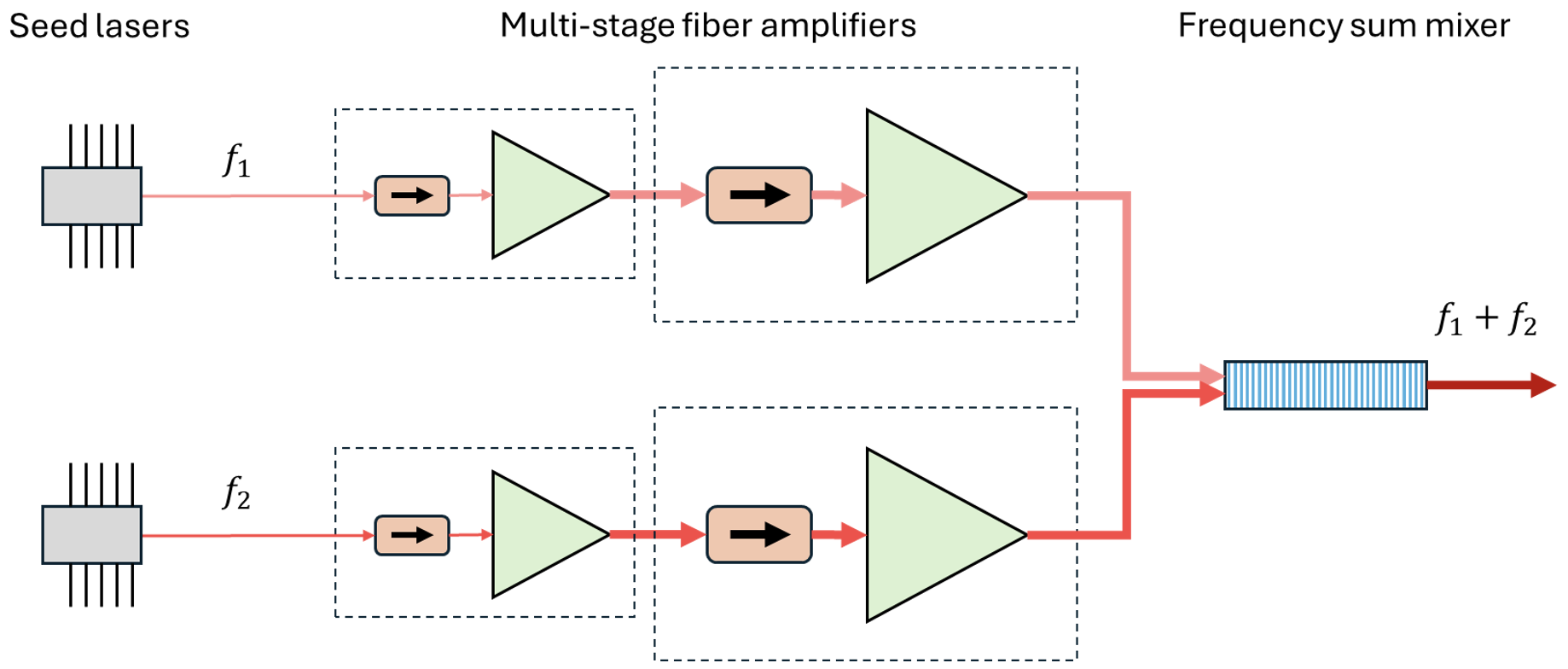
Sum-frequency generation (SFG) combines two single-frequency fundamentals in a nonlinear crystal to produce light at the sum of their optical frequencies (Figure 1). Because the two inputs usually come from different gain fibers — Yb (1012–1112 nm), Er (1530–1610 nm) and Tm (1730–2060 nm) — SFG reaches the wavelengths between our SHG bands (blue-shaded cells of Table 1). Using a frequency-doubled Tm amplifier (865–1030 nm) as one input (SHG+SFG) extends coverage further into the blue-green and yellow. The frequency sum mixer is integrated into the product and delivers a directly collimated beam, and the narrow linewidth and low noise of the fundamentals are preserved in the output.


QTekLaser™ lasers comply with Federal Regulations (21 CFR Subchapter J, Part 1040) as administered by the Center for Devices and Radiological Health and are certified to IEC 60825-1:2014 standards.