QTekLaser™ second-harmonic generation (SHG) fiber lasers use waveguide and cavity-free technology to deliver narrow-linewidth, polarization-maintaining light across 506–540 nm and 765–805 nm at power levels up to 22 W — extending fiber-laser performance into the visible and near-IR for quantum and atomic applications.
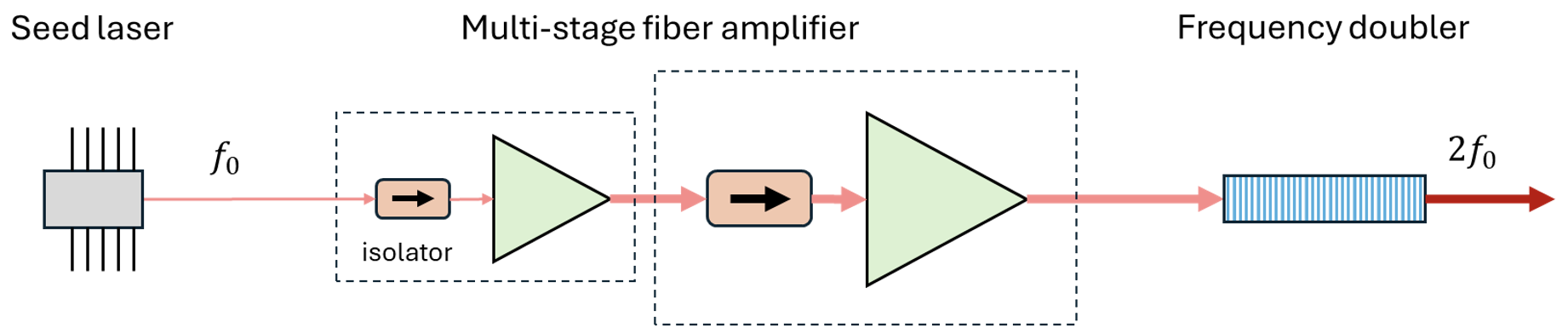
QTekLaser™ offers laser systems with extended wavelength range by combining nonlinear frequency conversion technologies. Through second-harmonic generation (SHG) we achieve significant laser power in the visible and NIR regime (figure 1; red-shaded cells of table 1). With the development of periodically poled crystal technology and the associated waveguide technology, nonlinear frequency conversion has become a powerful tool to extend the application scope of fiber lasers. For QTekLaser™ products, the max power of the converted laser light is constrained by the damage threshold of commercially available nonlinear crystals, which is typically several tens of watts.
SFG Output Wavelength Matrix
SF-AMP-Tm2 (865 – 1030 nm)
SF-AMP-Yb (1012 – 1112 nm)
SF-AMP-Er (1530 – 1610 nm)
SF-AMP-Tm (1730 – 2060 nm)
SF-AMP-Yb (1012 – 1112 nm)
466 – 535 nm
506 – 556 nm
SF-AMP-Er (1530 – 1610 nm)
553 – 628 nm
609 – 658 nm
765 – 805 nm
SF-AMP-Tm (1730 – 2060 nm)
576 – 687 nm
638 – 722 nm
812 – 904 nm
865 – 1030 nm
Table 1. Wavelength extension of QTekLaser™ products via nonlinear frequency conversion. The red-shaded cells represent second-harmonic generation (SHG) and the blue-shaded cells sum-frequency generation (SFG).
Figure 1. QTekLaser™ fiber laser system with an integrated frequency doubler.
SHG Fiber Laser with Waveguide Technology
Specifications
QTekLaser™ lasers comply with Federal Regulations (21 CFR Subchapter J, Part 1040) as administered by the Center for Devices and Radiological Health and are certified to IEC 60825-1:2014 standards.
It is the end user's responsibility to ensure that no significant light is retroreflected back into QTekLaser systems as this can degrade performance and potentially damage the lasers. To prevent this, the use of an external optical isolator is strongly recommended. Damage due to retroreflected light is not covered under warranty.
Model: QT-LASR-SHG-767-2-A-2-2.0-0 and QT-LASR-SHG-770-2-A-2-2.0-0 are widely used for laser cooling and trapping of potassium atoms Model: QT-LASR-SHG-780-2-A-2-2.0-0 and QT-LASR-SHG-795-2-2-A-2.0-0 are widely used for laser cooling and trapping of rubidium atoms Model: QT-LASR-SHG-805-4-W-0-2.0-0 is widely used for optical tweezer trapping of neutral atoms
Performance
Power Stability: 780 nm
RIN vs Frequency: 795 nm 4W
SHG Conversion vs Pump Current
Spectrum of Fundamental Light
SHG Fiber Laser with Cavity-Free Technology
Specifications
Parameter
506-540 nm
765-805 nm
Output power
1-16 W
1-22 W
PER
20 dB
20 dB
Power stability
<1.5%
<1.5%
Laser linewidth
<20 kHz
<20 kHz
Operating temperature
17-25 °C
17-25 °C
Wavelength tuning range
0.5 nm
0.5 nm
Cooling mode
Forced air / Water cooling
Forced air / Water cooling
Beam quality
M2<1.25
M2<1.25
QTekLaser™ lasers comply with Federal Regulations (21 CFR Subchapter J, Part 1040) as administered by the Center for Devices and Radiological Health and are certified to IEC 60825-1:2014 standards.
It is the end user's responsibility to ensure that no significant light is retroreflected back into QTekLaser™ systems as this can degrade performance and potentially damage the lasers. To prevent this, the use of an external optical isolator is strongly recommended. Damage due to retroreflected light is not covered under warranty.