The QTekLaser™ 522 nm Fiber Laser is a green-wavelength system using second-harmonic generation (SHG) to deliver stable, narrow-linewidth (<10 kHz), polarization-maintaining light up to 1.5 W, ideal for optical tweezer arrays. With <1% power stability and an IoT-enabled interface in a compact 4U 19" rack-mount chassis, it is easily integrated into any system.
Need a different wavelength? The 522 nm system is one configuration of our second-harmonic (SHG) platform covering 506–556 nm. We routinely build custom wavelengths across this range. Tell us your target line.
Light-shift engineering and species- or state-selective trapping
Two-photon and specialized entanglement schemes
Research
Second-Harmonic Generation (SHG)
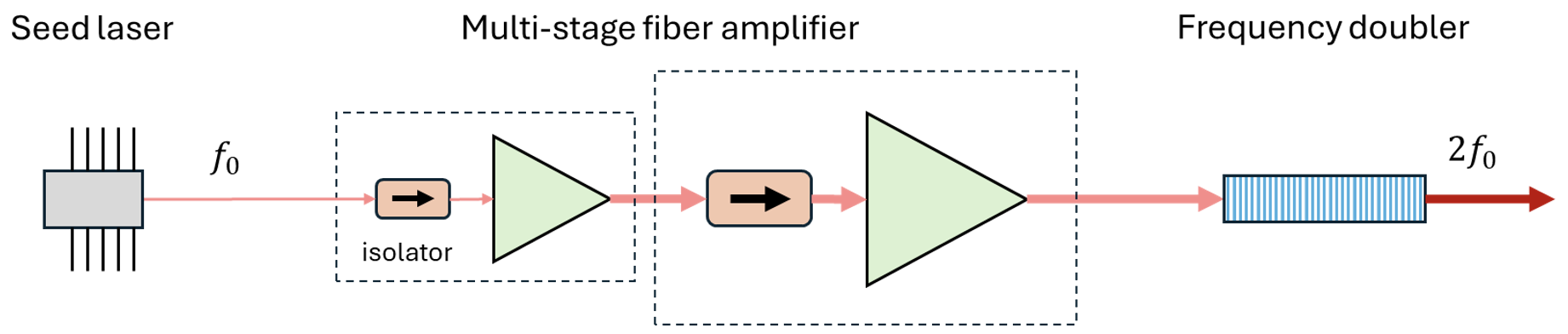
QTekLaser™ offers laser systems with extended wavelength range by combining nonlinear frequency conversion technologies. Through second-harmonic generation (SHG) we achieve significant laser power in the visible and NIR regime (figure 2; red-shaded cells of table 1). With the development of periodically poled crystal technology and the associated waveguide technology, nonlinear frequency conversion has become a powerful tool to extend the application scope of fiber lasers. For QTekLaser™ products, the max power of the converted laser light is constrained by the damage threshold of commercially available nonlinear crystals, which is typically several tens of watts.
SFG Output Wavelength Matrix
SF-AMP-Tm2 (865 – 1030 nm)
SF-AMP-Yb (1012 – 1112 nm)
SF-AMP-Er (1530 – 1610 nm)
SF-AMP-Tm (1730 – 2060 nm)
SF-AMP-Yb (1012 – 1112 nm)
466 – 535 nm
506 – 556 nm
SF-AMP-Er (1530 – 1610 nm)
553 – 628 nm
609 – 658 nm
765 – 805 nm
SF-AMP-Tm (1730 – 2060 nm)
576 – 687 nm
638 – 722 nm
812 – 904 nm
865 – 1030 nm
Table 1. Wavelength extension of QTekLaser™ products via nonlinear frequency conversion. The red-shaded cells represent second-harmonic generation (SHG) and the blue-shaded cells sum-frequency generation (SFG).
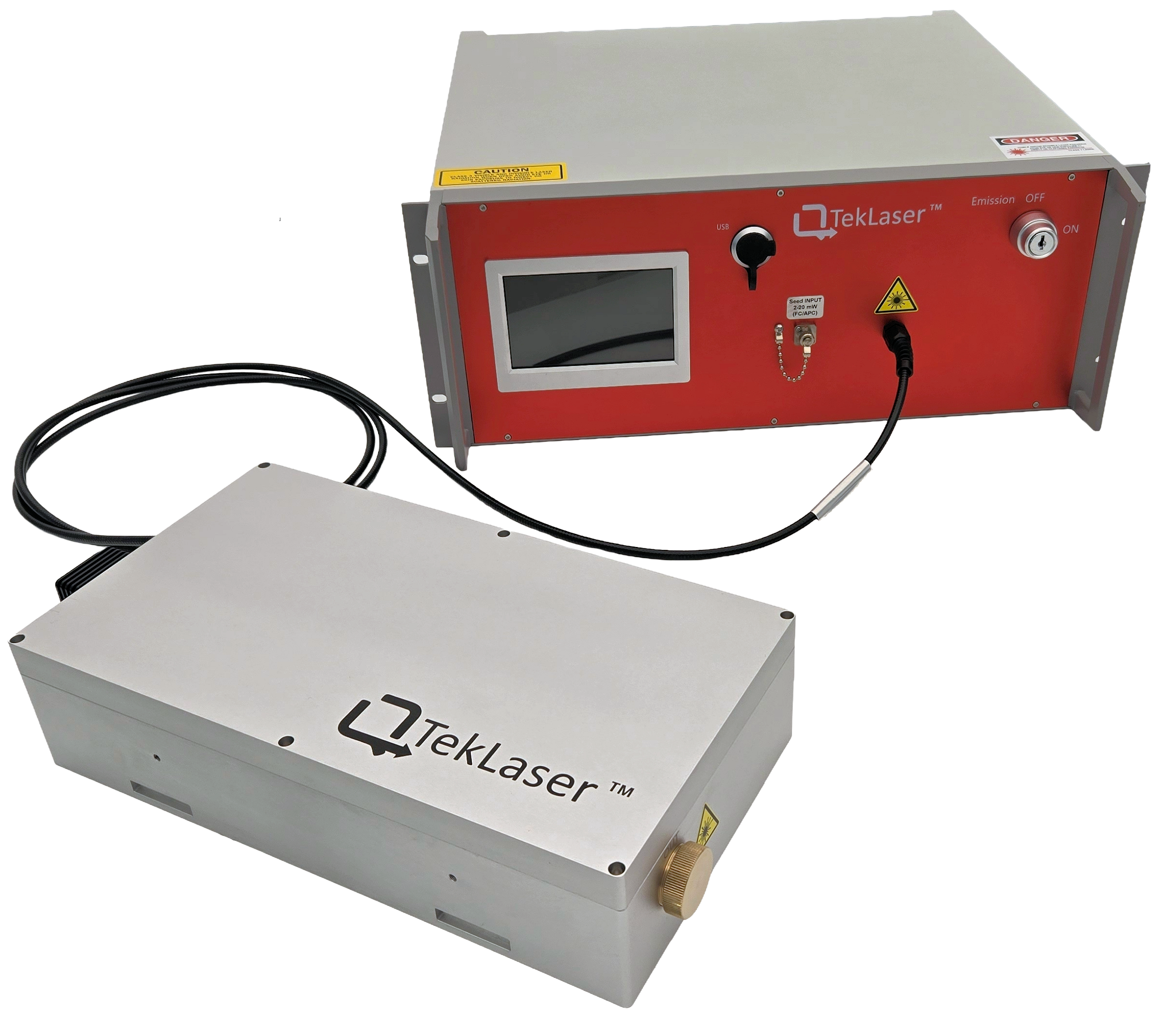
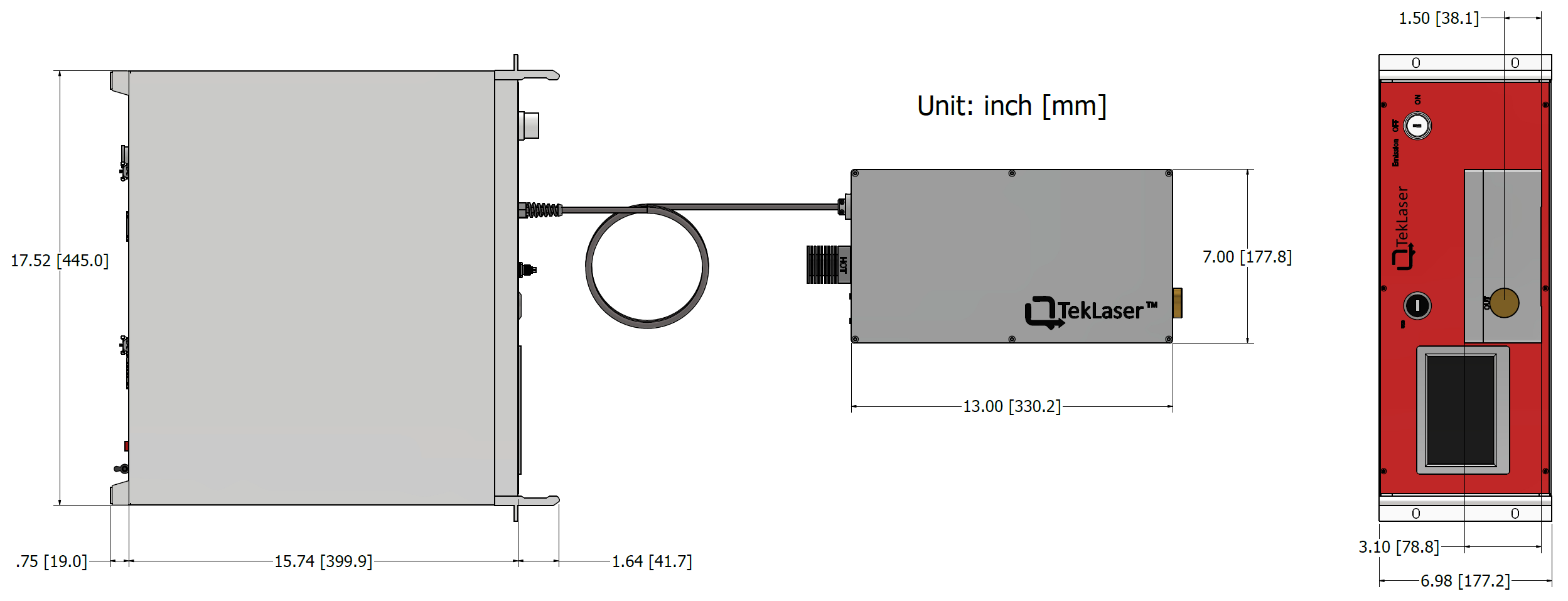
Figure 2. QTekLaser™ fiber laser system with an integrated frequency doubler.
QTekLaser™ lasers comply with Federal Regulations (21 CFR Subchapter J, Part 1040) as administered by the Center for Devices and Radiological Health and are certified to IEC 60825-1:2014 standards.
It is the end user's responsibility to ensure that no significant light is retroreflected back into QTekLaser™ systems as this can degrade performance and potentially damage the lasers. To prevent this, the use of an external optical isolator is strongly recommended. Damage due to retroreflected light is not covered under warranty.
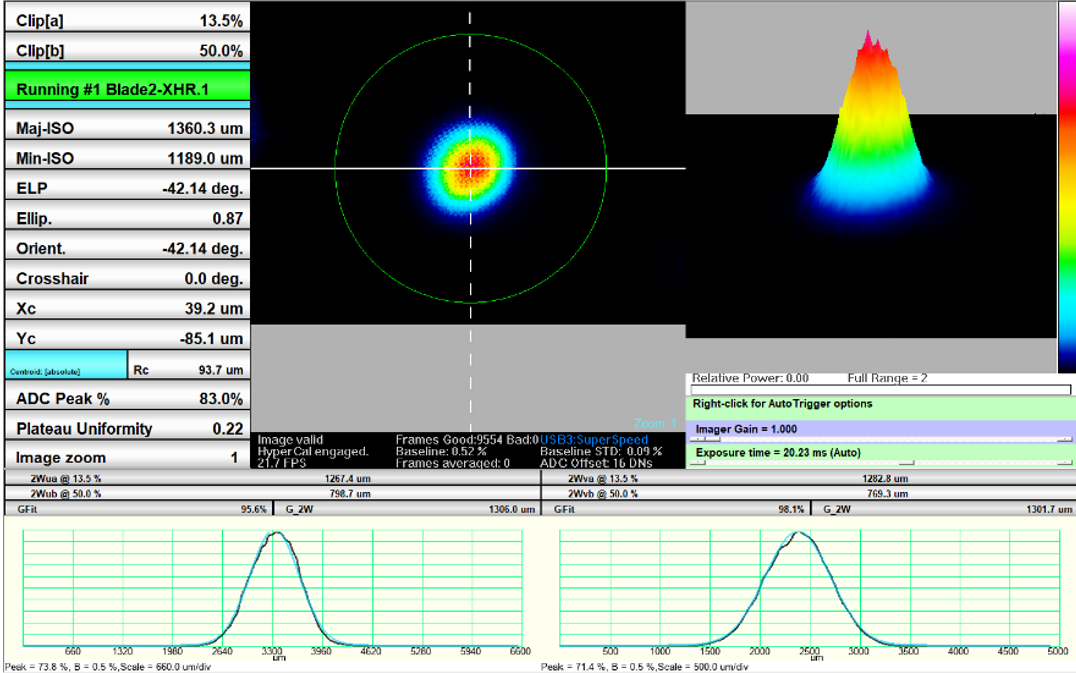
Figure 4. Beam Profile 522 nm. 1/e² beam diameter of 1.3 mm horizontally and 1.3 mm vertically.
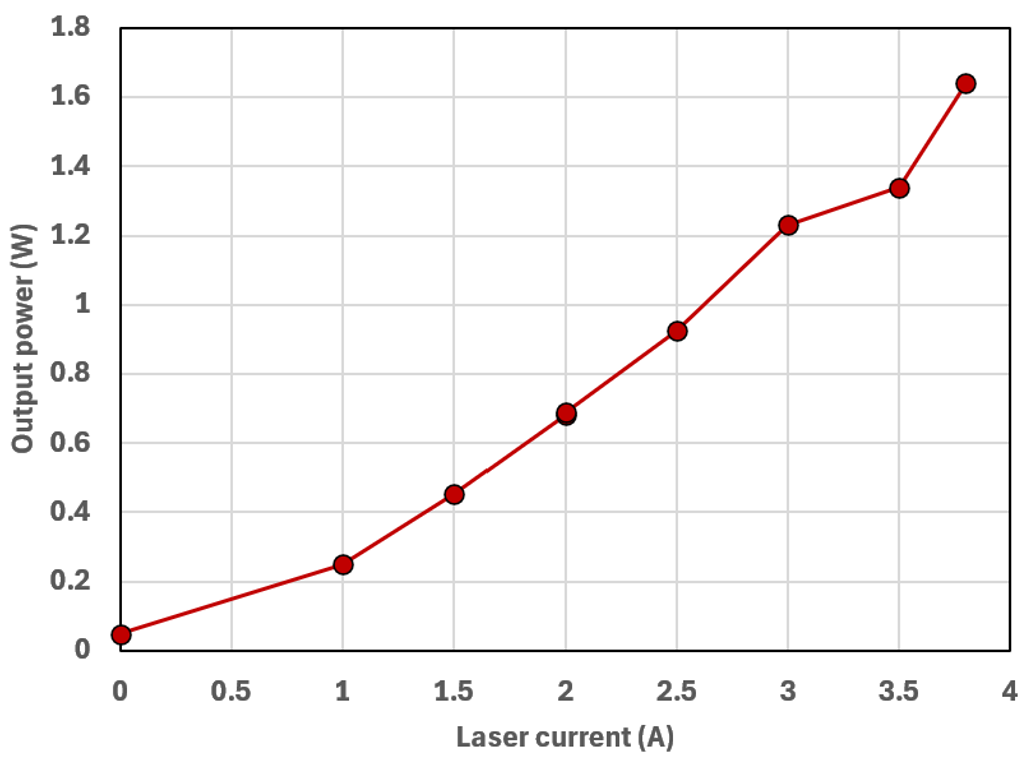
Laser Power vs. Current
Figure 5. Laser Power vs. Current: 522 nm
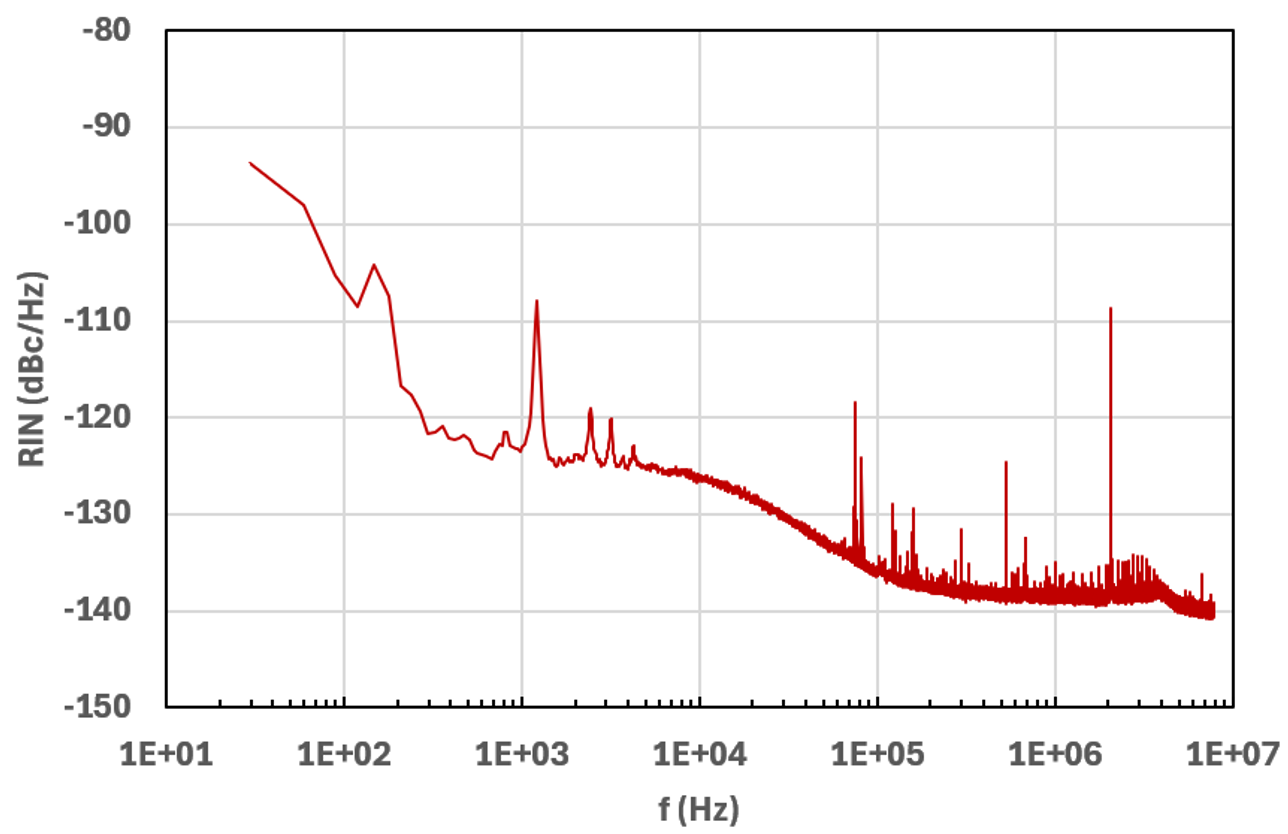
Relative Intensity Noise (RIN)
Figure 6. Relative Intensity Noise (RIN): 522 nm <-125 dBc/Hz >10 kHz. The spikes observed below 10 kHz and around 2 MHz originate from the ECDL seed laser used during the measurement.
Quantum Applications
In the green, the 522 nm laser is built for neutral-atom tweezer platforms. Its low-noise, 1.5 W single-frequency output drives optical tweezer arrays and dynamic atom rearrangement, optical-lattice and dipole trapping, and light-shift engineering for species- or state-selective trapping, thereby maintaining trap depth and coherence across large arrays.